G League
| Team name | G League |
|---|---|
| League | NBA G League |
| Founded | 2001 |
| Season | October to March (Regular Season) |
| Structure | 30 teams (NBA-affiliated) |
| Standings determinant | Win–loss record |
| Governing body | National Basketball Association (NBA) |
Overview
The NBA G League is the official minor league basketball organization of the National Basketball Association. It functions as a developmental league for players, coaches, officials, and front-office staff aspiring to reach the NBA. The league consists of teams that are either directly affiliated with an NBA franchise or operate as independent clubs. The G League season typically runs concurrently with the NBA season, beginning in the fall and concluding in the spring, with its own playoffs and championship. Its primary purpose is to provide a competitive platform for player development and evaluation one step below the premier level. The league has grown significantly from its origins, now featuring over 30 teams and serving as a critical pipeline for NBA talent.
History
The league was founded in the United States in the early 2000s, with its first season taking place in the 2001-2002 timeframe. It was originally known as the National Basketball Development League (NBDL) before being renamed the NBA Development League (NBA D-League) and later rebranded as the NBA G League following a sponsorship agreement. Initially launched with eight teams in the southeastern United States, its structure was quite different, as it operated with a shared roster model not directly tied to specific NBA clubs. The league's expansion and formalization of the affiliate team system occurred gradually over the following decade. This evolution was driven by the NBA's desire to create a more structured and cohesive development pathway. The adoption of the one-to-one affiliate model, where nearly every NBA team now has its own G League counterpart, became standard in the 2010s.
How it works today
The G League operates on a franchise model where most teams are singly affiliated with an NBA parent club, sharing management, coaching systems, and offensive and defensive schemes. Teams play a regular season schedule of approximately 50 games, followed by a playoff tournament to crown a league champion. Player rosters are composed of draft-eligible prospects, NBA assignment players, affiliate "rights" players, and local tryout participants. NBA teams can assign players under contract to their G League affiliate for playing time and development, a process known as a "NBA assignment." The league also holds an annual draft for eligible players not already under an NBA affiliate's control. Additionally, the G League Ignite team operated as an alternative pathway for top prospects, though it was a distinct program separate from the traditional affiliate structure and is no longer active.
What to know
The G League's standings and playoff structure are self-contained, meaning a team's performance does not directly impact its NBA affiliate's standing. However, individual player performance is closely monitored by NBA front offices for potential call-ups, known as "10-day contracts" or standard NBA contracts. The league has specific roster designations, including "Two-Way Contracts," which allow players to split time between an NBA roster and its G League affiliate, with salary and active-day limits defined by the NBA's Collective Bargaining Agreement. G League salaries are standardized and publicly known, differing significantly from NBA salaries, and players earn more based on their years of service and contract type. The path through the G League is not linear, with many players having extensive international or collegiate experience before joining. Success in the G League does not guarantee an NBA opportunity, as roster spots are limited and depend on specific NBA team needs.
Common questions
What is the difference between being assigned to the G League and being a G League player? An NBA-assigned player is under an NBA contract and sent down for development, while a G League player signs a contract directly with the league or a team. How does a player get into the G League? Pathways include the annual draft, local tryouts, being designated as an affiliate "rights" player, or signing a Two-Way Contract. Do G League teams travel as extensively as NBA teams? Travel is regionalized to reduce costs, with more bus trips and shorter flight schedules compared to the NBA. Can anyone try out for a G League team? Open tryouts are held by most teams, but selected participants are extremely rare and typically fill the final roster spots. What happens if a G League team wins the championship? The team wins a title, but the primary focus for the organization remains the development of individuals for the NBA. Are G League games televised? Many games are available through streaming services and some through select television networks, though coverage is not as widespread as the NBA.
Why it matters
The G League provides an essential, structured proving ground for the vast majority of basketball talent not immediately ready for the NBA. It offers a controlled environment where players can refine skills, adjust to professional schedules, and learn professional systems under the direct guidance of an NBA organization. For the NBA, it is a valuable asset for developing draft picks, rehabilitating injured players, and evaluating fringe talent in a competitive setting without the pressure of NBA standings. The league's existence has fundamentally changed the pre-draft process, giving younger players a professional alternative to collegiate basketball. It also serves as a crucial resource for coaching and executive development, creating a pipeline for off-court talent. Furthermore, it expands the professional basketball landscape in North America, providing more employment opportunities and fan engagement in cities without NBA teams.
Common misconceptions
A common misconception is that the G League is solely for young, raw prospects; in reality, it includes many veteran players with extensive international experience who are seeking a route back to the NBA. Another is that dominating the G League statistically guarantees an NBA roster spot, but NBA call-ups depend heavily on fitting a specific team's positional need and defensive scheme. Some believe G League play is of low quality, but the level is considered highly competitive, featuring many players with NBA athleticism who lack only consistency or a specialized role. There is also a mistaken belief that all NBA teams are required to have a G League affiliate, though the goal is universal affiliation, it is not yet a mandatory rule. Finally, some assume the league operates at a financial loss for all involved, but while it is a cost center for NBA teams, its value is measured in player development and organizational synergy, not direct profitability.
Latest G League news
Latest reporting
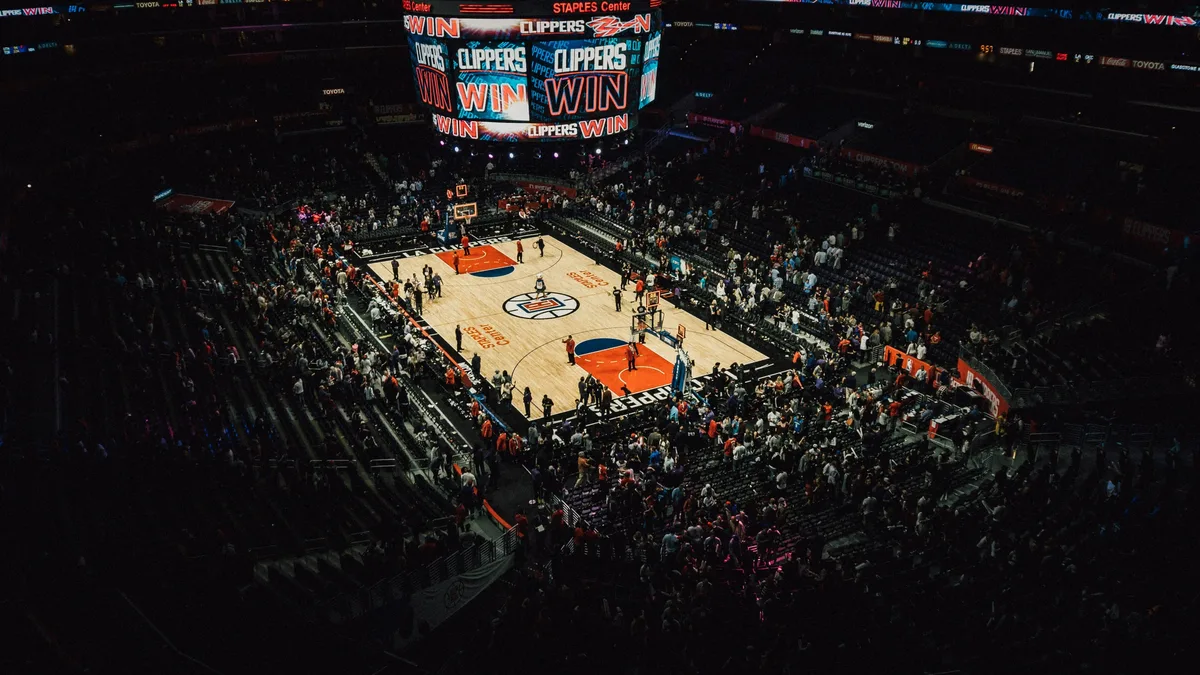
Los Angeles Clippers Face Historic NBA Salary Cap Penalty
The NBA fined the Clippers $30 million and stripped five first-round draft picks for salary cap circumvention, one of the largest penalties in league

Nets Add Dainja, Humrichous to Training Camp Roster
The Brooklyn Nets have signed forwards Dain Dainja and Ben Humrichous to training camp deals, with both players likely to join the G League's Long...
Adou Thiero's Rotation Path for Lakers
The Lakers' 2025 second-round pick Adou Thiero aims to carve out a rotation role after an injury-plagued rookie season, showing promise in Summer...

Longest-Tenured NBA GMs
NBA teams have seen significant turnover in their front offices over the past couple years, with 11 changes among the league's 30 teams since 2024.
Cameron Carr seeks to end Lakers' decade-long first-round
Cameron Carr aims to break the Lakers' streak of no impact from first-round draft picks since Lonzo Ball in 2017, with his Summer League performance

SB Nation Launches Free NBA Fan App
SB Nation has released a free mobile app for iOS and Android, designed as a dedicated space for NBA fans to discuss teams and league-wide topics.